|
If
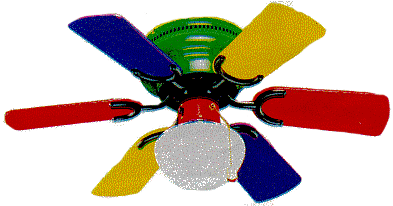
we wanted to throw an object through this compact disc, it would have to
be very swift and very small. If we intended to
shatter this wheel, we would have to choose a big and slow object.
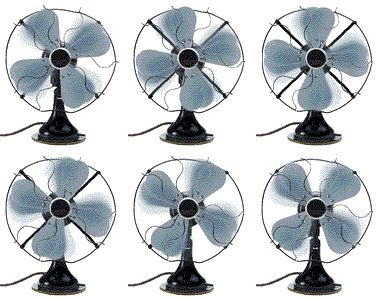
The acceleration of the blades reduces the duration of one revolution.
The resistance they put up against us because of their rotation could be
called “apparent mass” because logically it is only the kinetic
energy of the blades which stops us from entering. Well, when we equate
this energy with the observed effect, i.e. the mass, we realise
that it is the rotational velocity of the fan which can change
the fan’s appearance. Thus the difference between energy and mass
results obviously from a coefficient of velocity. This will remind many
of us immediately of Einstein’s famous formula:
E=mc2
In this formula, a velocity, namely that of light, is also decisive
whether an event appears as energy or as mass. But we will deal with
this formula at a later point.
When
we now remove all blades except for one and call this fragment, which is
nearly invisible during rotation, “quantum of action” (a favourite
trick of the physicists), we still don’t find any “mass” in the
whole model which would correspond to our observation. Therefore we
don’t want to use such an imaginary concept for mass as an argument at
all. Up to now we have discovered only three concepts which are
obviously responsible for the image of the cosmos: space, time, and
energy.
The
search for the world formula has been a goal that scientist have been
striving for since time immemorial. Of course, the universe is not
designed according to one formula – and therefore such a search is
quite futile. After all, that would be as if a baker could make all his
produce according to one single recipe! But if there was such a
universal formula it could only be restricted to those three concepts
which we discovered, and actually it would have to be immanent to or be
the basis of all calculations of our so-called reality in some way.
Shall we try to create a world formula with these three concepts? Would
it be possible to express the relationship of these three abstract
quantities mathematically?
When
we pay close attention to how these three concepts are related to each
other in
our fan wheel, the following strange equation is the result:

That
should be all? Is this strange formula of any use? We are going to verify
it immediately with a little
mathematics:
Let’s
assume the fan blade of our thought experiment is approx. 32 cm long. The
path of its revolution is thus ca. 2 meters. Now, we are making the blade
rotate giving it a velocity
of one revolution per second - i.e. 2m/sec. Since we do not believe in
“real mass“ we invent the term apparent mass
in order to paraphrase an action of mass of the accelerated blade (even if
professional physicists are getting into a flap right now!). At the same
time we postulate: the quantum of action of the non-moving blade equals 1
“blade“ - and it doesn’t matter in the least what we would like
to understand by that because all dimensions and units of this
world were chosen arbitrarily. Even the physicists use “Planck’s
quantum constant“ in their calculations in a similar way. And 1 blade is
just our empirically determined quantum of action.
Thus
absolutely unconcerned we are calculating:

2 what? 2 meters? But it looks as though the quantum of action of the blade has already doubled, i.e. 2 “blades“. Well, it has to be more than the non-moving blade, hasn’t it? But this does still not impress us considerably. In truth, we only just calculated the travel by means of the velocity. Newton did something very similar with the velocity of the planets (v²) - and what he calculated by means of the orbital radius (r) was one fictitious cause of the planetary motion, a centre of “mass” in kg! For that purpose he needed additionally a coefficient of proportionality, the constant of gravitation, which he had to estimate by rule of thumb because Cavendish determined it only about 100 years
later.
Well, therefore we won’t be bothered by any objection and continue: we are stealing the time from the blade, and it is getting so fast that it only needs one sixteenth of a second for one revolution. Of course, that means that its speed becomes sixteen times higher (now the mathematics are getting into the same flap as the physicists).
The result is 512 “blades“. Should this number now really express the present effect, possibly the action of mass (quantity of matter) ? Does the obtained disc now really act as if it had 512 times the effect of the blade? And is this effect nothing else but the effect of kinetic energy? If this was the case we should be able to calculate our originally assumed quantum of action of 1 “blade“ from this apparent mass by means of the usual formula for kinetic energy (kin.E=l/2 m•v2) which includes a mass after all. We rearrange the formula to
get:

and
unperturbed we substitute the kinetic energy with our apparent mass:

Thus, we really get again the effect 1 which we assigned to the blade. This confirms our suspicion that our apparent mass means the same as kinetic energy and from that we have to conclude that every action of mass we become aware of is based on an energy that works through motion.
Velocity, however, is travel divided by time; when we include the concept of space in our formula we get:
By
dividing space by the time squared we should logically get the value of
that energy which leads us to believe in the action of mass. This can be
easily verified, and for time we choose one sixteenth of a second which
yielded
the value 512:
Naturally we also get the number 512 this way. It reveals the magnitude of the “quantity of action“ – the mass by motion. And indeed the fan disc would offer a corresponding resistance. Apart from one constant which we invented to define a unit of action we were calculating with absolutely abstract concepts. Hence the world seems to consist of literally nothing! He who raises the objection that in fact the fan wheel has not increased its mass but its density is on the right track. Because we will discover in the chapters “Gravity“ and “Inertia“ that in truth not the masses play any role for the gravitational effects of bodies but the density of the
bodies.
Did we discover some kind of world formula with our little game? Of course not. But their relations are part of every calculation which is dealing with energy or mass. A universal formula for the existence of the world would have to be of similar design because it would have to do justice to this simple universe. The relation of space, time, and energy is at the bottom of all laws of nature, behind the free fall as well as behind the laws of conservation of energy and impulse which were postulated. All three concepts are inseparably linked with each other. Already this reminds us of the space-time of the general theory of relativity (but it does not refer to the systems of inertial of the special theory of relativity) and it applies to the whole cosmos which demonstrates this connection evidently by the expansion, the entropy, and the modification to interdepending “natural constants” (fine structure, gravitation, and velocity of
light).
Exhaustively, the only genuine building blocks of the universe are: energy, space, and time. Although our formula used measuring units like seconds and metres – which don’t have any absolute significance in the universe - we could at least demonstrate the connections. We are unable to actually calculate anything with
them!
The constant 1 “blade“, the effect, already depends on our perception. Therefore, the world is not a material event of substance, so to speak, but a kind of “mental occurrence“ – just as many philosophers already suspected. Nevertheless the picture of a material universe in which masses have an effect on each other is created in our mind by the play of resistance and harmony and the multitude of
encounters.
For that reason, we must not assume that those three concepts are genuine, established objects within an absolute reality – because we know after all that basically only T.A.O. exists. Space, time, and energy are effects of T.A.O., actually they are only informational events of the same kind as a holography which - consisting only of light - can reproduce an image of everything nevertheless! These effects or rather our perceptions of energy, space, and time are the only definable building blocks whereas T.A.O. remains indefinable for us in the end...
Every oscillating proton represents nothing else but our fan wheel. If one wants to do justice to the insubstantiality of this world and to develop an extensive theory about it nevertheless, only a general field theory will lead to the goal. Einstein knew that as well, and he was working on it until his death. But he was unable to accommodate gravitation and electric forces. Even the quantum theory to which he actually contributed, does not always agree with his theories of relativity without force. Therefore we will have to deal with this topic in more detail at a later point.
Physics already works with many field concepts. Fields are simply spaces filled by forces, impulses, or energies. The proton is such a space and the term “field” is more suitable for it than particle or even atom. All concepts connected with the word atom, both concerning its indivisibility and its independence as world-building, contestable object, have been regarded as outdated for a long time after all. In the following we will call the proton field “spherical field” as well in order to have our own name for our own child. And we will see the universe as a single infinite field in which everything is contained that can develop from energy, space, and time. And that also means the “masses” which - as we just saw - are only a special form of energy.
|